- -10%

Tillandsia originates from southern Mexico , where it grows attached to tree branches in dry, sunny areas.
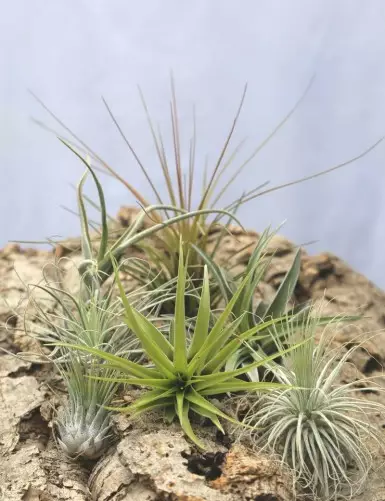
It is recognizable by its fine, slightly silvery foliage, forming a supple and harmonious clump.
Discreet yet refined, it is particularly appreciated in minimalist settings, light pendants and natural airy compositions.
A delicate, luminous, and highly decorative species, Tillandsia pueblensis is easy to grow and ideal for bright interiors. Requiring no soil and requiring minimal maintenance, it is suitable for both beginners and collectors seeking an elegant air plant.
Sold without stand.
.png) 3 shipments per week
3 shipments per week
Usual shipments on Mondays, Wednesdays and Fridays, subject to service constraints.
 Secure payment
Apple Pay, PayPal, Credit Card, Bancontact, Ideal, Check, Bank Transfer
 Packaging and cushioning
24 years of experience in packaging our plants. 100% recycled or reused.
To make Tillandsias more beautiful and healthier, it is recommended to remove completely dry or damaged leaves and to remove the inflorescences.
Grow outdoors during the warmer months, perhaps alongside cacti for a more striking effect!
Place it indoors or outdoors in the summer when the weather is nice.
Temperatures ranging from 10°C to 30°C on average .
Water with rainwater or demineralized water . You can either soak the Tillandsia for a few seconds in water, or spray it on the foliage .
In winter, watering every two days is sufficient. In summer, and generally when the air is hot and dry, misting should be done once or twice a day.
The plants need to dry out between waterings .
In spring and summer, it's beneficial to mist the Tillandsia with orchid fertilizer diluted to a quarter strength , twice a month . Tillandsias in our latitudes don't find the nutrients they need for optimal growth under ideal conditions, hence the need for a little extra help.
Avoid direct sunlight in summer, especially during the hottest hours.
In winter, find a bright spot.

Tillandsia originates from southern Mexico , where it grows attached to tree branches in dry, sunny areas.
It is recognizable by its fine, slightly silvery foliage, forming a supple and harmonious clump.
Discreet yet refined, it is particularly appreciated in minimalist settings, light pendants and natural airy compositions.
A delicate, luminous, and highly decorative species, Tillandsia pueblensis is easy to grow and ideal for bright interiors. Requiring no soil and requiring minimal maintenance, it is suitable for both beginners and collectors seeking an elegant air plant.
Sold without stand.